
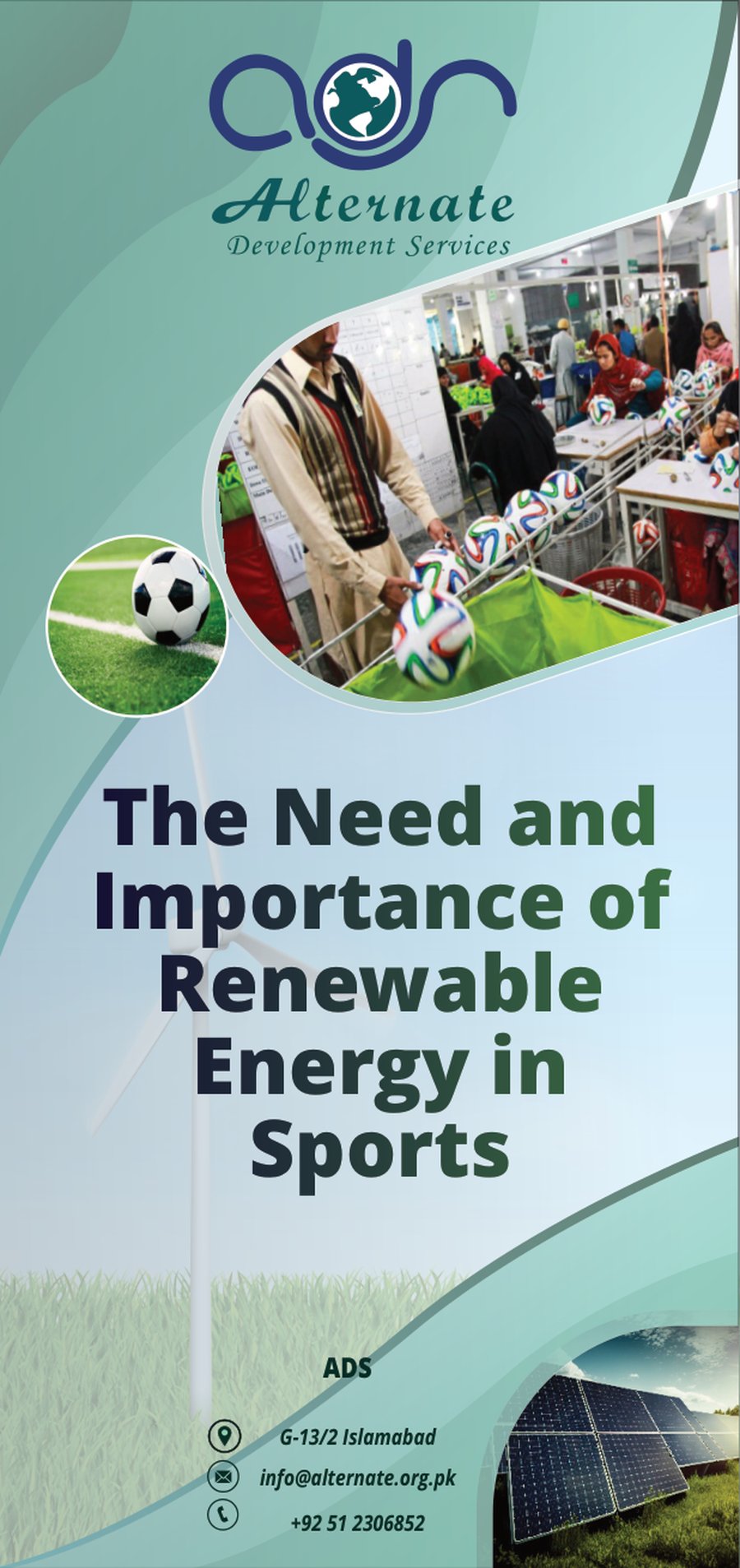
A sector briefing on the sports goods industry's energy use and pathway to clean power.
Summary
A tri-fold advocacy pamphlet by ADS, "The Need and Importance of Renewable Energy in Sports," on the case for renewable energy adoption in Pakistan's sports goods manufacturing sector, centered on Sialkot — the "World Capital of Sports Goods" — covering the sector's economic scale, competitive pressures, and the efficiency, cost, and environmental benefits of switching to renewables.
Key Points
- 1Profiles Sialkot's sports goods industry: about 1,000 manufacturing units employing over 60,000 people, exporting roughly $400 million worth of sports goods in 2022 — a significant increase over the previous year — with footballs alone accounting for more than 50% of total sports-goods exports.
- 2The sector contributes about 1.5% to Pakistan's GDP, with the European Union, United States, and United Kingdom as its major export markets, and faces rising competition from China, India, Vietnam, and Bangladesh on both quality/price and environmental compliance.
- 3Makes the cost case for solar: says immediate costs can drop by at least 15% by adopting renewables, notes solar panel and battery prices have fallen significantly with payback recoverable within a few years, and cites studies showing renewable energy can be cheaper than coal in the long run.
- 4Lists real examples already underway in the industry: some manufacturers using solar and wind power directly, others recovering waste heat from production processes to generate electricity, and others using biomass such as sugarcane bagasse.
- 5Concludes the sector needs to embrace renewable energy to "stay competitive and meet international environmental standards," framing it as a way to simultaneously cut costs, reduce environmental impact, and gain a competitive edge globally.