
Exploring Competitive Trading Bilateral Contracts Market (CTBCM) through Fingertips' Model
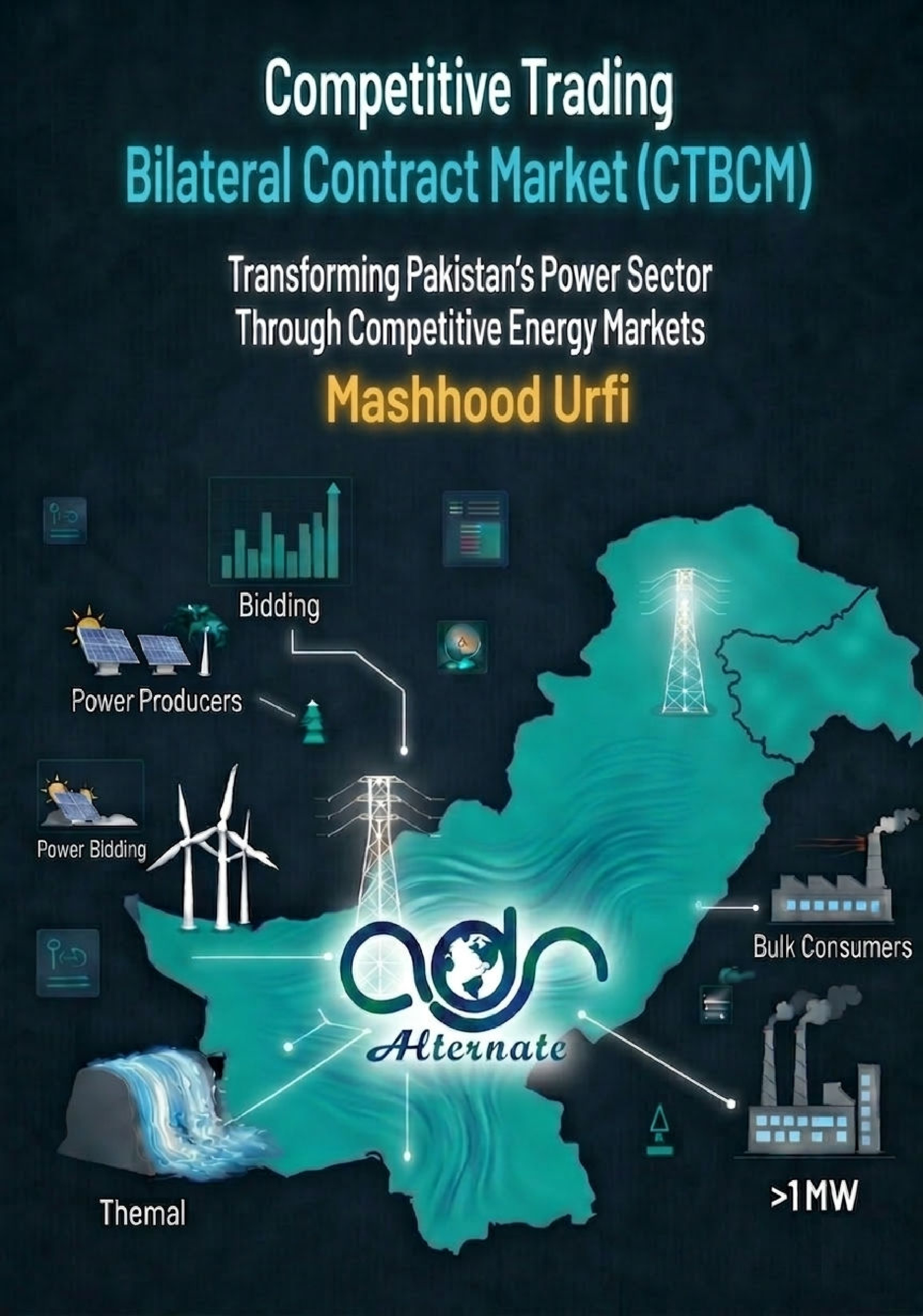
Traces CTBCM's evolution since its May 2022 launch from the old Single-Buyer Model, with a 2030 outlook drawing on NEPRA and World Bank data.
Summary
This March 2026 ADS report traces the origins, current status, and future outlook of Pakistan's Competitive Trading Bilateral Contracts Market (CTBCM), the electricity market reform approved by NEPRA in November 2020 and officially launched on 31 May 2022 that lets bulk power consumers (1 MW and above) contract directly with generators, bypassing the single-buyer model previously run by CPPA-G. Drawing on NEPRA, CPPA-G, NTDC, IEEFA, World Bank, ADB, Renewables First and SDPI data, it traces the sector's reform history since the 1992 WAPDA unbundling plan, documents the circular debt crisis and industrial cost impacts under the single-buyer regime, profiles Pakistan's current generation capacity mix and demand forecasts through 2035, and draws comparative lessons from other countries' market reforms.
Key Points
- 1CTBCM was approved by NEPRA in November 2020 and officially launched on 31 May 2022, allowing bulk power consumers of 1 MW or above to contract directly with generators.
- 2Pakistan's power sector carries a persistent generation surplus of 10-17 GW, with capacity payments (payable regardless of dispatch) surging from PKR 0.97 trillion in FY22 to PKR 1.9 trillion in FY24, and average fleet utilization at only 34% in 2024.
- 3The textile sector, accounting for 60% of Pakistan's exports and 40% of industrial labour, was hit hardest under the single-buyer regime, with captive generation adding 8-12% to unit production costs.
- 4By March 2025, Pakistan's installed capacity reached about 46,605 MW against peak demand of about 29,000 MW, with net-metered rooftop solar capacity at about 4,900 MW after 17 GW of solar PV panels were imported in 2024 alone.
- 5Electricity demand forecasts for 2025-2035 vary from about 120 to 240 TWh by FY2035 depending on the scenario (IGCEP base/high demand, IEEFA estimate, or a low-growth solar-and-efficiency case).