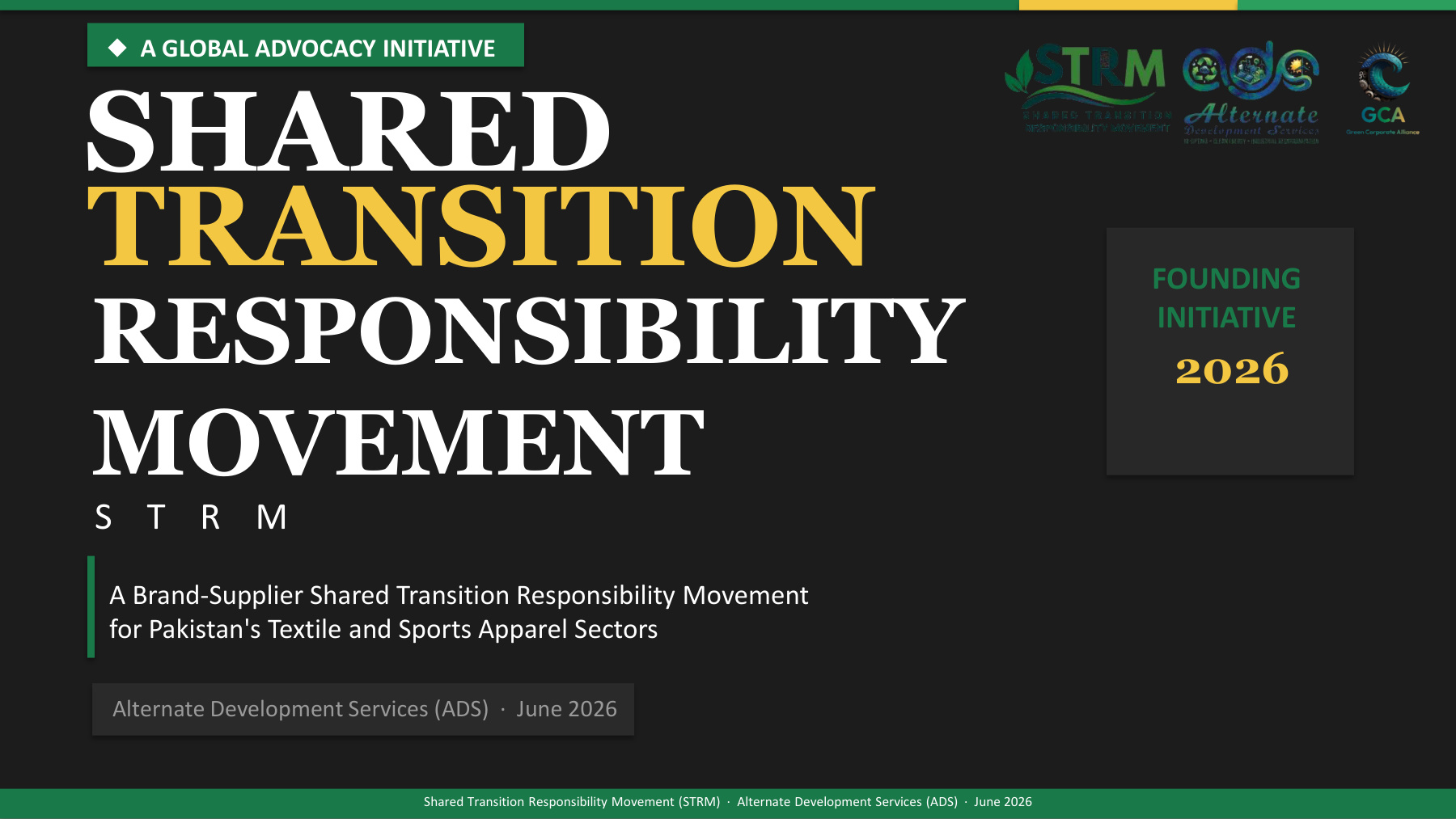
The founding framework document outlining STRM's coalition model and shared responsibility principle.
Summary
This is the founding conceptual framework deck (ADS, June 2026) for the Shared Transition Responsibility Movement (STRM), a global advocacy initiative arguing that international brands bear shared moral and financial responsibility for decarbonizing the Pakistani textile and sports & apparel supply chains they profit from. It introduces the Pakistan Shared Transition Responsibility Consortium and lays out a 3-pillar Brand-Supplier Shared Responsibility Model and 6 operational mandates for turning that principle into practice.
Key Points
- 1Frames the core problem with the line "Compliance without co-investment is extraction" — arguing brands must share moral and financial responsibility for decarbonizing supply chains they profit from, not just impose compliance mandates on suppliers.
- 2Opens with a snapshot of Pakistan's textile sector: $17.9bn in exports for FY26 (60% of national merchandise exports, 8.5% of GDP, 40% of the industrial labour force), still powered mostly by natural gas (30%), coal (26.7%), and grid electricity (15%) — noting textile exports held flat at +0.26% while national exports fell 5.97%.
- 3Frames "The Asymmetry" between what brands bring to a sourcing contract (climate targets, standards and audits, reputational upside, discretionary purchasing power) and what suppliers carry (capital expenditure, financing cost, compliance labour, and commercial risk).
- 4Cites scale figures for context: Pakistan's textile & apparel exports exceed $19B annually, account for 55% of the country's total export earnings, and support millions of livelihoods that depend on the sector's stability.
- 5Built around 3 pillars: (1) Invest Together — direct financial/technical co-investment by brands in supplier-level renewable energy; (2) Procurement is Climate Policy — 5-10 year sourcing agreements with advance payments and phased compliance instead of delisting threats; (3) Measure What Matters — joint MRV infrastructure to track Scope 2/3 emissions for CBAM, CDP, and SBTi reporting.
- 6Establishes the Pakistan Shared Transition Responsibility Consortium — bringing international brands, IFC/ADB/DFI partners, textile and sports goods manufacturers, government bodies, sustainability standard-setters, and civil society "to the table" — and lays out 6 operational mandates: Evidence & Advocacy, Brand-Supplier Partnerships, an MRV Platform, a Green Finance Facility, Procurement Reform, and Scope 3 Reporting.